
Rohu
Labeo rohita
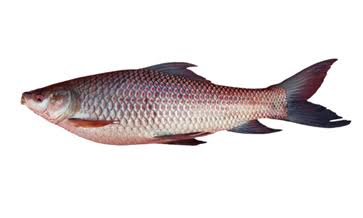
Identification
The most economically significant Indian Major Carp, with a bilaterally symmetrical, moderately elongate body and a dorsal profile more arched than ventral. Covered in cycloid scales with a scaleless head, blunt depressed snout, and small inferior mouth with thick fringed lips. Bluish back transitioning to silvery flanks and belly. Can reach 35–45cm and 700–800g within its first year under optimal conditions.
Culture Method
Cultivated in semi-intensive to intensive pond polyculture, typically with Catla and Mrigal. Due to its broader column-to-bottom feeding niche, Rohu is usually stocked at higher densities — often 30–40% of total stock. Requires induced breeding (pituitary extracts or synthetic hormones); fry are reared in nursery ponds for 15–20 days, then fingerling ponds for 2–3 months, before roughly a year in grow-out ponds.
Water Quality
| Parameter | Optimal Range | Notes |
| Temperature | 25°C – 32°C | Growth slows significantly below 14°C |
| Dissolved Oxygen | >5.0 mg/L | Essential for active feeding |
| pH | 7.5 – 8.5 | Slightly alkaline preferred |
| Total Alkalinity | 80 – 150 mg/L | Buffers pH fluctuations |
Regular monitoring and controlled feeding prevent stress and ensure high growth rates.
Feed
Planktivorous in early life (rotifers, cladocerans), maturing into an essentially herbivorous column feeder — diet shifts to phytoplankton, algae, submerged vegetation, and decayed organic matter, aided by soft fringed lips adapted for nibbling. Natural productivity is stimulated via manures and fertilizers, supplemented with rice bran and oilcake; modern farms increasingly use formulated pellets.
Diseases
- Parasitic: Argulosis, Lernaeasis, Trichodiniasis
- Bacterial: Aeromonas/Pseudomonas — hemorrhagic septicemia, dropsy, ulcer disease
- Fungal: Saprolegniasis — cold months or after physical injury
Economics
Highly profitable due to strong consumer demand across South Asia. Input costs are relatively low compared to carnivorous species like trout — mainly pond lease/maintenance, seed, fertilizers, and supplementary feed. Utilizing natural pond productivity reduces reliance on artificial feed. Integrating Rohu into KP's warm-water carp clusters (Peshawar Basin, D.I. Khan) supports commercialization and poverty alleviation goals.